Portfolio demonstration · Healthcare operations platform
Hospital Management System
A portfolio demonstration exploring how a hospital operations product could coordinate administrative work without treating sensitive information like ordinary dashboard data. It is not a deployed clinical system or evidence of regulatory certification.
- Evidence type
- Portfolio demonstration
- Who it serves
- Administrative staff, scheduling teams, service departments, finance roles, and authorized managers in a hospital setting.
- Maxspace role
- Product modelling, UX decisions, frontend implementation, and backend implementation
The product and its operating context
This portfolio demonstration explores how connected records and role-aware workflows could support hospital administration. It is not a deployed clinical product, certified medical system, or claim of regulatory compliance.
Product
Healthcare operations platform
Users
Administrative staff, scheduling teams, service departments, finance roles, and authorized managers in a hospital setting.
Scope
Patient records, Appointments, Staff workspaces, Billing administration, Operational dashboards.
Classification
Portfolio demonstration. This classification defines what the case study does—and does not—claim.
The operational problem behind the interface
Fragmented patient, appointment, staff, billing, and service workflows force teams to repeat work while making responsibility and record status harder to see.
Project goals
- Create a consistent path through patient registration and appointment activity
- Limit information and actions according to operational responsibility
- Reduce repeated administrative handling across connected workflows
Evidence boundary: No hospital stakeholder validation, jurisdiction-specific compliance assessment, clinical integration, or production security review is claimed. These are mandatory discovery areas for any real deployment.
What needed to be understood before solution decisions
Discovery was treated as a domain-modelling exercise: which records belong together, which responsibilities must remain separate, and where sensitive information changes the acceptable design.
- Mapped administrative journeys around registration, appointments, services, staff, and billing
- Identified distinct role responsibilities and information needs
- Separated administrative concepts from clinical claims
- Prioritized record consistency, visibility, and permission boundaries
- Documented production unknowns around jurisdiction, compliance, integrations, retention, and clinical safety
A high-level view of the system
Identity, scheduling, patient, service, and billing concerns remain in separate domain modules behind an authenticated API. That separation reduces unintended dependencies between sensitive workflows.
Role-aware application
Angular provides separate administrative workspaces while reusing shared interaction and record patterns.
Domain API
Node.js and Express separate identity, scheduling, patient, service, staff, and billing operations behind authenticated interfaces.
Structured records
MongoDB supports the demonstration's connected entities while keeping domain responsibilities distinct.
Access control
Permissions are considered according to role and action, with sensitive operations protected on the server.
Integration boundaries
Laboratory, pharmacy, payment, identity, messaging, and clinical systems remain explicit external dependencies rather than assumed features.
Deployment and data responsibility
Hosting region, encryption, backups, audit, retention, recovery, and incident ownership would require jurisdiction-specific agreement.
Why the stack was used
Technology choices are described in the context of this project. They are not universal recommendations for every product.
Angular
Selected for a structured multi-workspace application with shared form, routing, and component patterns across administrative roles.
Node.js and Express
Used to centralize validation, permissions, and domain operations while keeping the API separable from the user interface.
MongoDB
Supported flexible demonstration models during exploration. A production choice would require deeper review of consistency, reporting, audit, and integration needs.
REST APIs
Made domain actions and access boundaries explicit and prepared the system for separately governed integrations.
Role-aware authentication
Necessary because access depends on operational responsibility. Production identity choices would also consider organization policy, session controls, and audit requirements.
Features organized around responsibility
Patient administration
- Registration
- Patient summaries
- Record lookup
- Service history context
- Status visibility
Scheduling
- Appointment creation
- Availability context
- Status management
- Role-specific views
- Conflict awareness
Hospital operations
- Staff workspaces
- Service administration
- Department context
- Task visibility
- Management oversight
Billing and reporting
- Service records
- Billing administration
- Operational summaries
- Filtered reporting
- Traceable actions
Interface decisions that reduce uncertainty
Responsibility-led navigation
Navigation follows the work each role performs rather than exposing every module to every user.
Record clarity
Status, ownership, and next action remain visible around patient and appointment records.
Error prevention
Sensitive or consequential actions require clear labels, validation, and confirmation rather than relying on memory.
Responsive behavior
Administrative summaries and schedules adapt to smaller screens while preserving labels and action priority.
Accessibility direction
Keyboard operation, focus, labels, contrast, semantic controls, and understandable errors are treated as essential for production review.
Where the difficult decisions sit
Modelling connected sensitive workflows
Patient, appointment, staff, service, and billing records must connect without collapsing into one unrestricted data model. Domain boundaries keep responsibilities clearer.
Enforcing role permissions
Access was considered by action and information type, with authorization expected at the API rather than only in navigation.
Preserving traceability
Operational changes need identifiable state and ownership. The concept uses explicit actions and prepares for audit-ready events in production.
Avoiding false compliance confidence
Security and compliance gaps are documented as production requirements instead of presenting a portfolio demonstration as deployment-ready healthcare software.
How production risk would be addressed
Quality assurance
- Validate role-specific journeys and permission boundaries
- Check patient, appointment, service, staff, and billing relationships
- Test required fields, invalid states, duplicate records, and failed operations
- Review sensitive information exposure in screens, logs, and errors
- Verify responsive behavior, keyboard paths, labels, contrast, and focus
- Require stakeholder, security, compliance, and clinical-safety validation before any production claim
Security considerations
- Use strong authentication appropriate to organization policy and user risk
- Enforce least-privilege authorization on every sensitive server operation
- Validate and normalize all record and API inputs
- Protect secrets, credentials, and environment-specific configuration outside source code
- Define encryption, audit, retention, backup, recovery, and incident requirements
- Complete jurisdiction-specific privacy, security, compliance, and clinical-safety review before deployment
These are product-specific considerations and review activities. They are not claims of certification, regulatory approval, absolute security, or completed production assurance.
Optimize against real usage, not abstract scores
Record retrieval
Use indexed queries, bounded results, and role-appropriate fields rather than transferring complete records unnecessarily.
Schedules and history
Paginate or window large appointment and activity datasets according to real usage.
Reporting
Separate expensive operational reporting from latency-sensitive administrative actions where scale requires it.
Interface delivery
Load data and modules according to the active role and task instead of exposing the full system at once.
Monitoring
Production planning should include visibility into failed integrations, access anomalies, application errors, and service health without logging sensitive content.
What the product is designed to improve
- A clearer model for connected administrative workflows
- More explicit responsibility across operational roles
- A foundation for the security and compliance work a production system would require
Lessons and future direction
Healthcare administration cannot be treated as a generic CRUD dashboard. A production path must begin with verified stakeholder workflows, jurisdiction, information classification, role governance, audit needs, integrations, recovery, and clinical-safety boundaries.
The outcome statements above describe intended operational improvements. No unverified KPI, revenue, adoption, or client result is implied.
Project gallery
The interface in context
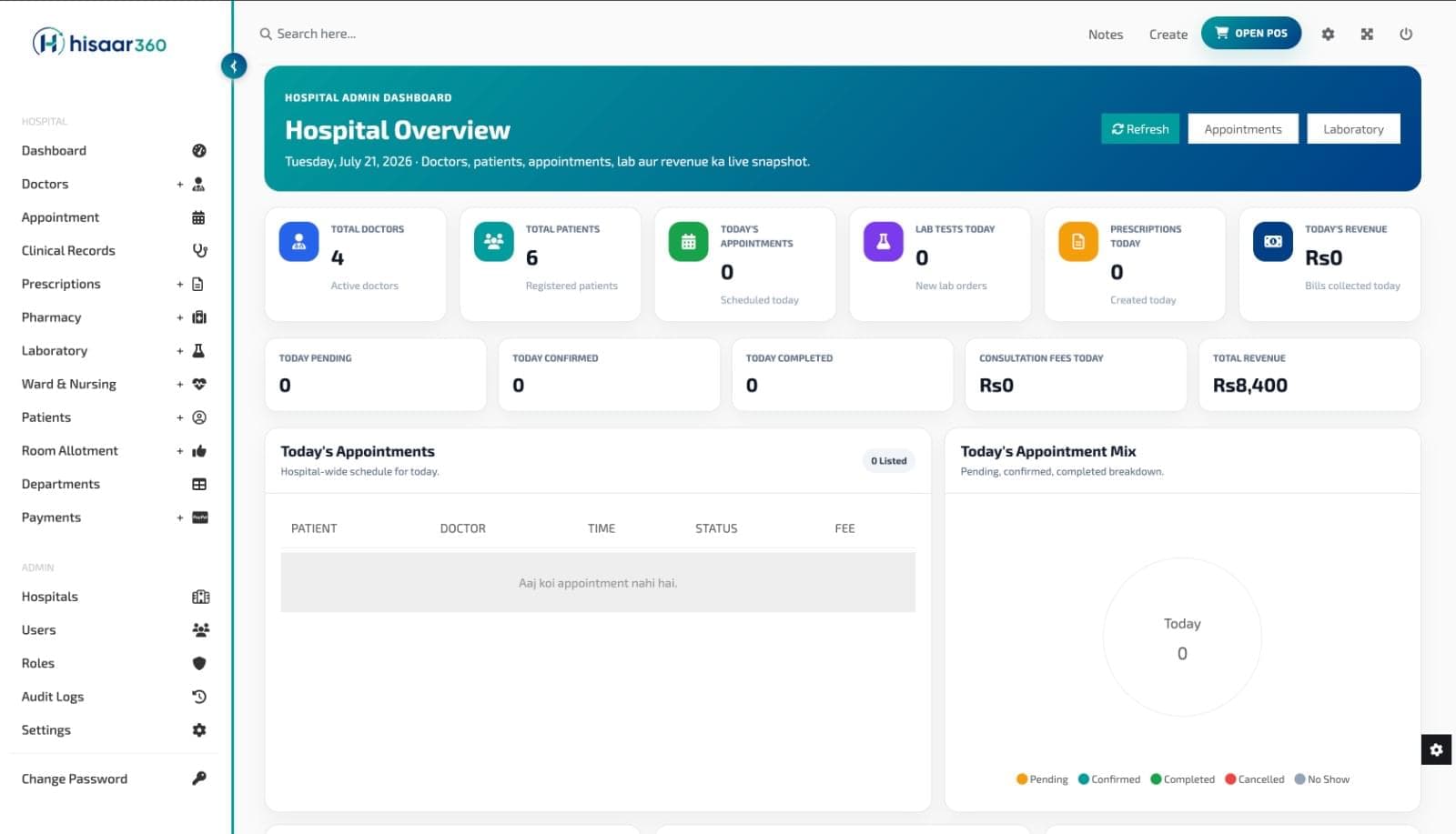
Screens are shown without decorative device frames so the information hierarchy and product behavior remain visible.


Tools grouped by responsibility
Frontend
Backend
Database
Authentication
Infrastructure
Tools
Planning something similar?
Discuss the business problem before committing to a solution
Share the current workflow, users, integrations, constraints, and intended change. We will identify what must be validated before responsible scope or architecture decisions are made.
Discuss your project